
The Anti-List A Creative Tool for Clarity Through What You Will Not Do

A blank page can feel too open. A new project can sprawl before it even begins. Ideas multiply, standards blur, and every possible direction starts to look equally valid. That is when a strange tool becomes useful: a written list of what will not happen.
The anti-list is a creative boundary on paper. It names the methods, tones, habits, features, subjects, and distractions that are off the table. Instead of asking, “What could this become?” it asks a sharper question: “What must this never become?”
That negative space can reveal the real shape of the work.

The anti-list gives a project edges
Creative work often begins with appetite. The writer wants the essay to include every thread. The designer wants the poster to carry every visual idea. The musician wants the track to hold every texture. The product maker wants the tool to serve every use case.
The anti-list interrupts that hunger.
It might say:
No nostalgic tone
No clever title that hides the subject
No stock phrases
No more than three colors
No features added to please imaginary users
No scenes set in restaurants
No explaining the joke
No work after 8 p.m.
Each refusal cuts away a path. At first, that can feel limiting. Then the relief arrives. The project no longer has to solve every possible version of itself.
An anti-list works because creativity is not only selection. It is also rejection. The shape of a poem depends on the lines left out. A film depends on the shots removed. A recipe depends on the ingredients that never enter the pan.
The anti-list turns vague preference into visible constraint.
That visibility matters. A preference kept in the mind is easy to bend. A written refusal can be checked, questioned, and defended.
Negation can be more honest than aspiration
A normal to-do list flatters us. It speaks in goals, hopes, and movement. Draft the chapter. Make the prototype. Build the series. Finish the outline.
That has value, but it can hide confusion. A person may write “make it elegant” without knowing what elegance means for the work. The anti-list asks for proof by contrast.
If a room should feel calm, what will not be allowed?
No glossy surfaces
No loud pattern
No crowded shelves
No overhead glare
If an essay should feel direct, what must be avoided?
No throat-clearing opening
No invented authority
No ornamental language
No ending that repeats the introduction
The negative version is often easier to test. “Make it clear” can float. “No sentence longer than needed” gives the hand something to do.

This is why the anti-list can be so helpful at the start of a project. It does not demand a complete vision. It only asks for the dangers already known.
Many creators can name what they dislike before they can name what they want. That knowledge is not negative in the shallow sense. It is material. It contains taste, memory, standards, and scars from past work that went wrong.
A good anti-list is specific enough to use
A weak anti-list sounds like a mood board turned inside out.
“No bad writing.”
“No boring ideas.”
“No ugly design.”
These refusals feel true, but they do not guide action. They need sharper language.
A useful anti-list points to behaviors and choices that can be noticed. It names what someone could actually do by accident.
Vague refusal | Useful refusal |
No clutter | No more than one idea per section |
No boring visuals | No centered subject with plain background unless tension comes from stillness |
No overexplaining | No paragraph that restates the previous one |
No trend-chasing | No reference added only because it is popular this month |
The best items are concrete enough to catch the hand in motion. They create a small alarm.
For example, a composer might write, “No dramatic swell in the final minute.” That single line prevents an easy emotional trick. A photographer might write, “No golden-hour comfort shots.” That forces a different kind of attention. A novelist might write, “No backstory in the first chapter.” That protects momentum.
The anti-list should not become a cage. It should remain a tool. If a forbidden choice turns out to be necessary, the list can change. The point is not obedience for its own sake. The point is awareness before default choices take over.
The anti-list protects the work from false generosity
Creative projects often get weaker because they try to be generous in the wrong way. They add more for the imagined reader, viewer, listener, client, or user. More explanation. More features. More references. More decoration. More options.
Some additions help. Many dilute.
The anti-list protects the center by saying, “This project will not pay every debt.” It will not serve every audience. It will not answer every question. It will not prove every credential. It will not carry every idea the creator loves.
That sounds stern, but it can make the final work kinder. A focused piece asks less of the person receiving it. The experience becomes easier to enter.

This also helps with collaboration. Teams often argue over additions because each idea has some merit. An anti-list gives the group a shared standard.
If the agreement says, “No feature that requires a tutorial,” then a clever but complicated feature has to justify itself. If the agreement says, “No joke that breaks the narrator’s voice,” then humor must serve the piece rather than steal attention.
Refusal becomes less personal when it was written down before the conflict.
How to write one before the work gets crowded
An anti-list does not need ceremony. Ten minutes can be enough. The key is to write it before the project becomes too full.
Start with a plain sentence:
This project will not include...
Then finish it with specific refusals. Aim for 5 to 10 items. Fewer than five may be too loose. More than 10 can turn the list into anxiety.
A strong first anti-list might include these kinds of limits:
Tone limits No sarcasm. No sentimental ending. No imitation of a favorite artist.
Structural limits No flashbacks. No extra navigation. No section without a clear purpose.
Material limits No new tools. No added colors. No outside references after the first draft.
Process limits No editing while drafting. No asking for feedback before the rough version exists. No late-night revisions.
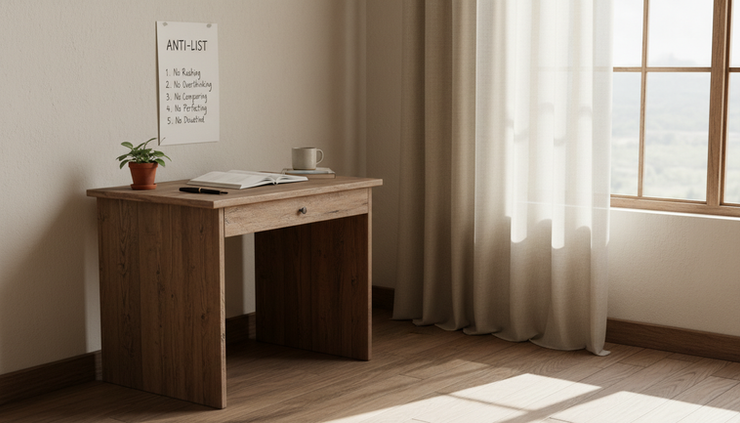
Read the list before each work session. Keep it visible near the materials, not buried in a folder. When the project stalls, check whether it has broken one of its own refusals.
The anti-list is especially useful during revision. Drafting invites abundance. Revision asks for judgment. A clear record of what will not be done can make cutting feel less like loss and more like return.
Refusal can be a form of care
Saying no is often treated as a failure of imagination. In practice, it can be one of imagination’s strongest supports.
The anti-list does not shrink a creative project. It helps the project recognize itself. By naming what will not be done, it clears room for the choices that matter. It replaces fog with edges. It turns taste into a working document.
The next time a project feels too broad, do not begin by adding more ambition. Write down the temptations you already know you need to resist. Keep the list close. Let the work grow against it.
The same hand behind the paintings works in mulberry silk under the Chiqui Rodriguez Studio seal. Pre-order at chiquirodriguez.com/studio.